
Introduction: Passwords Are Not Enough Anymore
Let me paint a picture you might recognize.
A customer logs into their banking app. They enter the correct username. They type the correct password. They pass the two-factor authentication check. By every traditional security measure, this person looks completely legitimate.
But it is not them. It is a fraudster who bought stolen credentials on the dark web, intercepted the OTP through a SIM swap attack, and is now sitting inside a verified banking session with full access to someone’s life savings.
This scenario plays out thousands of times every day across financial institutions worldwide. And it exposes a fundamental weakness in how online banking has traditionally approached authentication — it verifies what you know and what you have, but it has no way of verifying who you actually are.
That is exactly the problem behavioral biometrics was built to solve.
Unlike passwords, PINs, or even fingerprint scans, behavioral biometrics analyzes the unique way a person interacts with their device — how they type, how they move their mouse, how they hold their phone, how they swipe, how they navigate. These patterns are extraordinarily difficult to fake because they are not something you remember or carry. They are something you are.
In 2026, behavioral biometrics has moved from a cutting-edge experiment to a core component of fraud prevention strategy at serious financial institutions. This article covers the best behavioral biometrics authentication tools available for online banking right now, what to look for when evaluating them, and why this technology has become impossible to ignore.
What Is Behavioral Biometrics and How Does It Work?
Before diving into specific tools, it is worth understanding what behavioral biometrics actually analyzes and how it builds authentication decisions from that data.
Behavioral biometrics captures and analyzes patterns in how users physically interact with devices and applications. The signals it monitors include the following.
Keystroke dynamics — The rhythm, speed, pressure, and timing of how a person types. Everyone has a unique typing pattern that is remarkably consistent over time and extremely difficult to replicate.
Mouse movement patterns — The speed, trajectory, acceleration, and hesitation patterns in how a person moves their cursor. Bots and fraudsters exhibit fundamentally different mouse movement profiles than real users.
Touchscreen interaction — On mobile devices, behavioral biometrics analyzes swipe pressure, touch area, gesture speed, scroll behavior, and the angle at which a person holds their device.
Device orientation and movement — Accelerometer and gyroscope data from mobile devices captures how a person physically holds and moves their phone — patterns that are surprisingly individual and consistent.
Navigation behavior — How a user moves through an application, which elements they interact with first, how long they spend on each screen, and how their session flow compares to their historical pattern.
Cognitive patterns — Response times, decision-making patterns, and interaction hesitation that can indicate whether a session is being driven by a genuine user or by someone unfamiliar with the account.
All of these signals are captured passively — the user does not need to do anything differently. The system builds a behavioral profile over time and continuously compares active session behavior against that profile to generate a real-time risk score.
Why Behavioral Biometrics Matters Specifically for Banking
Financial services face a unique combination of security challenges that make behavioral biometrics particularly valuable.
Account takeover fraud has become sophisticated enough to defeat most traditional authentication methods. Credential stuffing attacks, phishing campaigns, social engineering, and SIM swapping have made stolen credential attacks a routine part of the fraud landscape rather than an exceptional event.
At the same time, banks face enormous pressure to reduce authentication friction for legitimate customers. Every unnecessary login challenge, every clunky verification step, every forced password reset is a customer experience failure that drives people toward competitors. The pressure to be both secure and frictionless creates a tension that traditional authentication methods cannot resolve.
Behavioral biometrics addresses both sides of this equation simultaneously. For legitimate users it is completely invisible — the authentication happens in the background without any interaction required. For fraudsters and bots it is a continuous, real-time barrier that passive credential theft cannot overcome.
The Best Behavioral Biometrics Authentication Tools for Online Banking in 2026
1. BioCatch

BioCatch is widely considered the gold standard in behavioral biometrics for financial services and has built one of the deepest track records in the industry over more than a decade of deployment across major banks worldwide.
What sets BioCatch apart is the depth and sophistication of its behavioral signal library. The platform analyzes over 2,000 behavioral parameters per session — far beyond basic keystroke and mouse dynamics — including cognitive biometrics that detect how users think and respond in addition to how they physically interact with their device.
BioCatch is particularly strong in two specific fraud scenarios that plague online banking. First, it has developed sophisticated detection capabilities for social engineering attacks — cases where a legitimate user is being manipulated by a fraudster on the phone while simultaneously conducting transactions online. The behavioral profile of a person under social engineering pressure looks measurably different from normal behavior, and BioCatch has trained its models specifically to catch this pattern.
Second, it excels at detecting mule account activity — accounts used to receive and quickly move fraudulently obtained funds. The way a person interacts with a mule account exhibits characteristic behavioral patterns that BioCatch’s models have learned to identify with high accuracy.
For large financial institutions handling millions of sessions daily, BioCatch offers enterprise-grade scalability, regulatory compliance support across major jurisdictions, and integration capabilities with existing fraud management platforms.
2. Nuance Gatekeeper (Now Part of Microsoft)

Nuance Gatekeeper has long been a leading platform in the voice biometrics space, and following its acquisition by Microsoft the platform has been significantly expanded to include comprehensive behavioral biometrics capabilities that go well beyond voice authentication.
The integration with Microsoft’s broader security and identity infrastructure gives Gatekeeper a distinctive advantage for banks already operating within the Microsoft ecosystem. The platform combines voice biometrics, behavioral signals, and conversational AI to create a multi-modal authentication profile that is substantially harder to defeat than any single modality alone.
For banks with significant call center operations alongside their digital channels, Nuance Gatekeeper offers particularly strong value — it can maintain a consistent behavioral identity across both digital interactions and phone-based customer service, creating a unified fraud prevention picture that neither channel-specific solution can match independently.
The platform’s passive voice authentication capability is especially compelling for banking use cases — it can authenticate a customer during the natural flow of a service call without requiring them to speak a specific passphrase, reducing friction to essentially zero while maintaining strong authentication.
3. Sardine
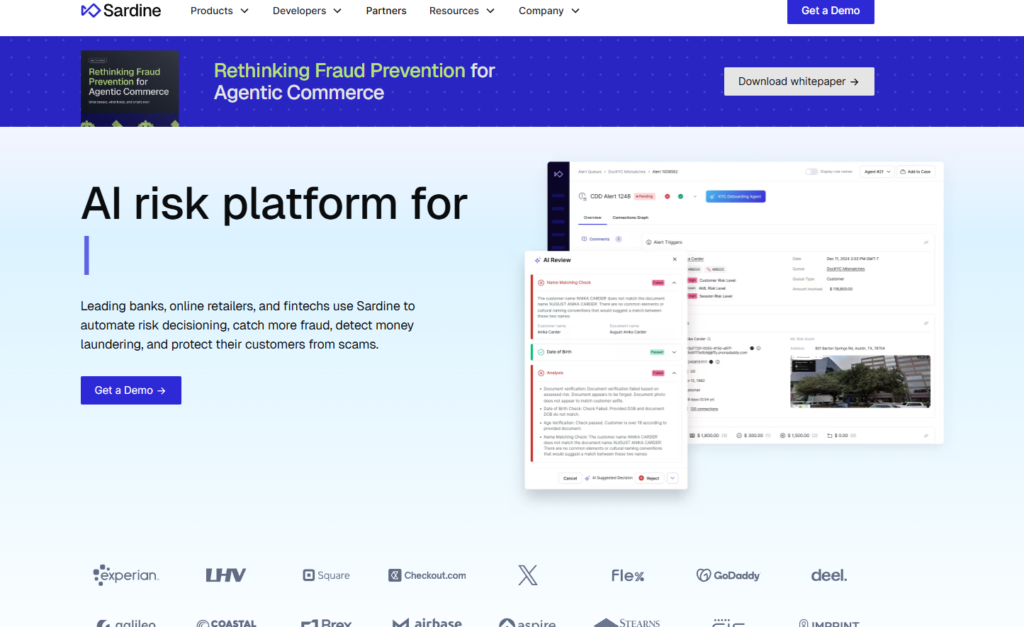
Sardine has emerged as one of the most talked-about behavioral biometrics platforms in fintech circles over the past few years, and its growth reflects how well it addresses the specific needs of digital-native financial services companies.
Where legacy behavioral biometrics platforms were built for traditional banking infrastructure and adapted to mobile and digital-first environments, Sardine was built from the ground up for digital financial services. Its behavioral signals are optimized for the interaction patterns of mobile banking, digital wallets, cryptocurrency platforms, and neo-banks rather than retrofitted from desktop-era models.
The platform combines behavioral biometrics with device intelligence, network analysis, and identity verification to create a comprehensive fraud prevention layer that addresses the full spectrum of threats facing digital financial services. For fintech companies and challenger banks that need fraud prevention sophistication without the implementation complexity and cost of enterprise legacy platforms, Sardine hits a sweet spot that few competitors match.
Sardine’s approach to combining behavioral signals with network-level intelligence is particularly effective against organized fraud rings, where individual behavioral profiles might look clean but network-level patterns reveal coordinated activity.
4. ThreatMetrix (LexisNexis Risk Solutions)

ThreatMetrix, now operating as part of LexisNexis Risk Solutions, brings something to behavioral biometrics that most pure-play providers cannot match — the world’s largest digital identity network.
The platform combines behavioral biometrics with device fingerprinting, IP intelligence, and a shared fraud intelligence network that spans billions of transactions across thousands of financial institutions, e-commerce platforms, and digital services. When a user lands on your banking platform, ThreatMetrix is not just analyzing their behavioral pattern in isolation — it is cross-referencing that device and behavior against its global network to identify patterns associated with known fraud activity across the entire ecosystem.
This network intelligence dimension gives ThreatMetrix a significant advantage in detecting fraud that has not yet occurred on your specific platform but has been identified elsewhere in the network. A device that has been used in account takeover attempts at three other banks shows up as high-risk before it ever completes a transaction with you.
For large banks and financial institutions that prioritize fraud intelligence at scale, ThreatMetrix’s network effect is a genuine differentiator. The behavioral biometrics layer sits on top of this broader intelligence foundation, creating a layered authentication approach that is substantially more robust than behavioral signals alone.
5. Callsign
Callsign takes a philosophy-first approach to behavioral biometrics that distinguishes it meaningfully from most competitors in the space. Rather than building a fraud detection system that happens to use behavioral signals, Callsign built an identity platform that uses behavioral biometrics as the foundation for ongoing, continuous authentication throughout the entire customer session.
The distinction matters. Most behavioral biometrics tools focus on the authentication moment — verifying identity at login or at transaction time. Callsign’s approach treats every interaction throughout a session as an authentication signal, continuously updating its confidence score in real time rather than making a single point-in-time decision.
For online banking specifically, this continuous authentication model is valuable because session hijacking — where a fraudster takes over a legitimate authenticated session after the initial login — is a growing threat that point-in-time authentication cannot address. Callsign’s continuous model detects the behavioral shift that occurs when session control passes from the legitimate user to an attacker, even mid-session.
The platform also places strong emphasis on user experience design, with a framework for orchestrating authentication challenges that are proportionate to the risk level detected — presenting frictionless authentication for low-risk interactions and stepping up to stronger verification only when behavioral signals suggest elevated risk.
6. Aware Inc. — Knomi
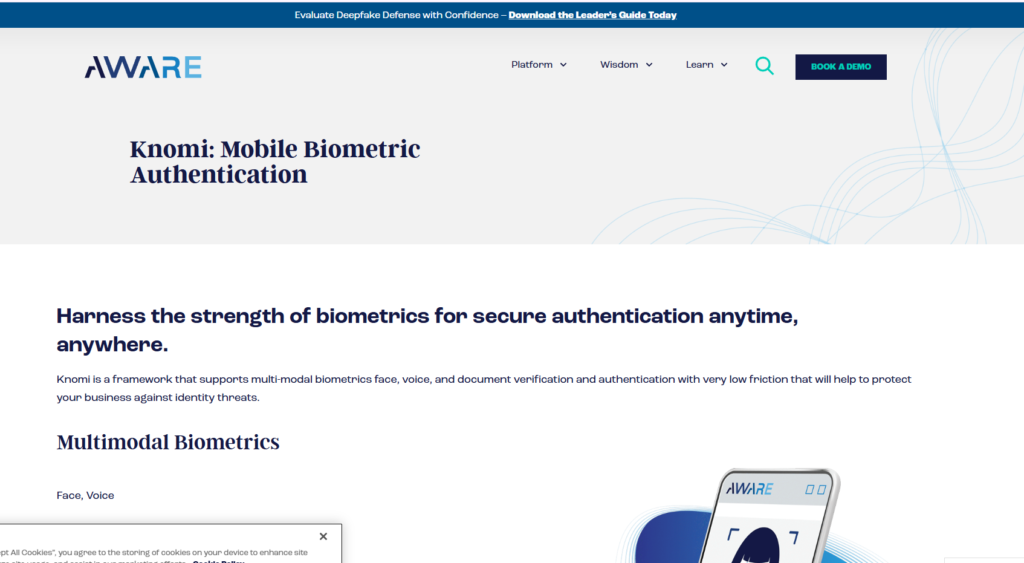
Aware’s Knomi platform approaches behavioral biometrics from a mobile-first perspective with particular strength in facial recognition combined with behavioral liveness detection — a combination that has become increasingly important as deepfake attacks on facial authentication have grown more sophisticated.
Knomi combines passive facial biometrics with behavioral signals from the device interaction context surrounding a facial authentication event — how the user held the device, how they positioned the camera, their movement patterns during the capture — to create an anti-spoofing layer that is substantially more robust than facial recognition alone.
For banks deploying mobile-first authentication strategies, the combination of Knomi’s behavioral liveness detection with its facial recognition capabilities creates a user experience that feels simple and natural while providing authentication depth that defeats both synthetic media attacks and traditional credential theft.
The platform has also invested heavily in fairness and accuracy across demographic groups — an important consideration for banking institutions that serve diverse customer populations and face regulatory scrutiny around algorithmic fairness.
7. Zighra

Zighra is a behavioral AI platform that has carved out a distinctive position by focusing on on-device behavioral biometrics — processing behavioral signals locally on the user’s device rather than sending raw behavioral data to a cloud server for analysis.
This on-device processing model has two significant advantages for banking applications. First, it dramatically reduces the privacy exposure associated with behavioral data collection by ensuring that raw behavioral signals never leave the user’s device. Second, it enables real-time behavioral authentication even in low-connectivity environments — important for banking customers in regions with inconsistent network access.
Zighra’s SensifyID platform builds a behavioral identity model that lives on the device and continuously authenticates the user based on their interaction patterns without requiring server round-trips for every authentication decision. The model updates continuously as the user’s behavior evolves, maintaining accuracy over time without manual recalibration.
For banks with strong data minimization commitments or serving markets with significant privacy sensitivities, Zighra’s on-device approach offers behavioral biometrics capabilities with a fundamentally different privacy architecture than cloud-based alternatives.
What to Look for When Evaluating Behavioral Biometrics Tools
With a growing number of vendors in this space, choosing the right platform requires clear evaluation criteria aligned with your institution’s specific needs and risk profile.
Accuracy and false positive rates — A behavioral biometrics system that generates too many false positives will frustrate legitimate customers and undermine trust in the technology. Demand rigorous accuracy benchmarks from any vendor, specifically false positive and false negative rates under real-world conditions rather than controlled test environments.
Passive versus active authentication — The best behavioral biometrics solutions authenticate users passively without requiring any additional action from them. Be wary of solutions that rely heavily on active challenges, as these reintroduce the friction that behavioral biometrics is supposed to eliminate.
Integration complexity — How difficult is the platform to integrate with your existing banking infrastructure, fraud management systems, and identity stack? Implementation timelines and technical requirements vary enormously between vendors.
Regulatory compliance — Does the platform support your compliance requirements under GDPR, PSD2, local financial services regulations, and any other applicable frameworks? Behavioral biometrics involves processing behavioral data that may qualify as personal data under various regulatory definitions.
Explainability — When a behavioral biometrics system flags a transaction as high-risk, can it explain why in terms that satisfy regulatory requirements and support human review decisions? Black-box models create compliance and operational challenges that transparent models avoid.
Adaptability to evolving fraud patterns — Fraudsters adapt. The behavioral biometrics platform you choose needs to continuously update its models based on new fraud patterns rather than relying on static models trained on historical data.
The Road Ahead: Behavioral Biometrics in 2026 and Beyond
The behavioral biometrics space is moving fast. Several trends are shaping where the technology is heading over the next few years.
Multimodal fusion is becoming the standard. The most effective fraud prevention strategies in 2026 combine behavioral biometrics with device intelligence, network signals, document verification, and traditional authentication factors into unified risk scores that no single modality can match.
Generative AI threats are accelerating the arms race. As AI-generated synthetic behavior becomes more sophisticated, behavioral biometrics vendors are responding with more complex signal libraries and adversarial training approaches designed to detect AI-generated behavioral patterns.
Regulatory frameworks around behavioral data are maturing. Banks deploying behavioral biometrics need to stay ahead of evolving guidance around consent, data minimization, and algorithmic transparency — requirements that will shape which platforms remain viable in regulated markets.
Federated learning is emerging as a privacy-preserving approach to improving behavioral models across institutions without sharing raw behavioral data — a development that could significantly accelerate the accuracy improvements that currently require massive individual datasets.
Conclusion
The authentication challenge facing online banking in 2026 is fundamentally different from what it was five years ago. Credential theft is industrialized. Synthetic identity fraud is sophisticated. Social engineering attacks are psychologically refined. And customers expect frictionless digital experiences that traditional security measures make impossible to deliver.
Behavioral biometrics does not solve every problem. But it addresses the core weakness that every other authentication method leaves exposed — the inability to continuously verify that the person in an authenticated session is actually who they claim to be.
The tools covered in this article represent the strongest options available today for financial institutions serious about building authentication systems that are genuinely difficult to defeat without degrading the experience of the legitimate customers they are built to protect.
The question for banking institutions in 2026 is no longer whether to implement behavioral biometrics. The question is which platform fits your architecture, your customer base, your regulatory environment, and your fraud risk profile — and how quickly you can get it into production.
Because the fraudsters are not waiting.

Leave a Reply