
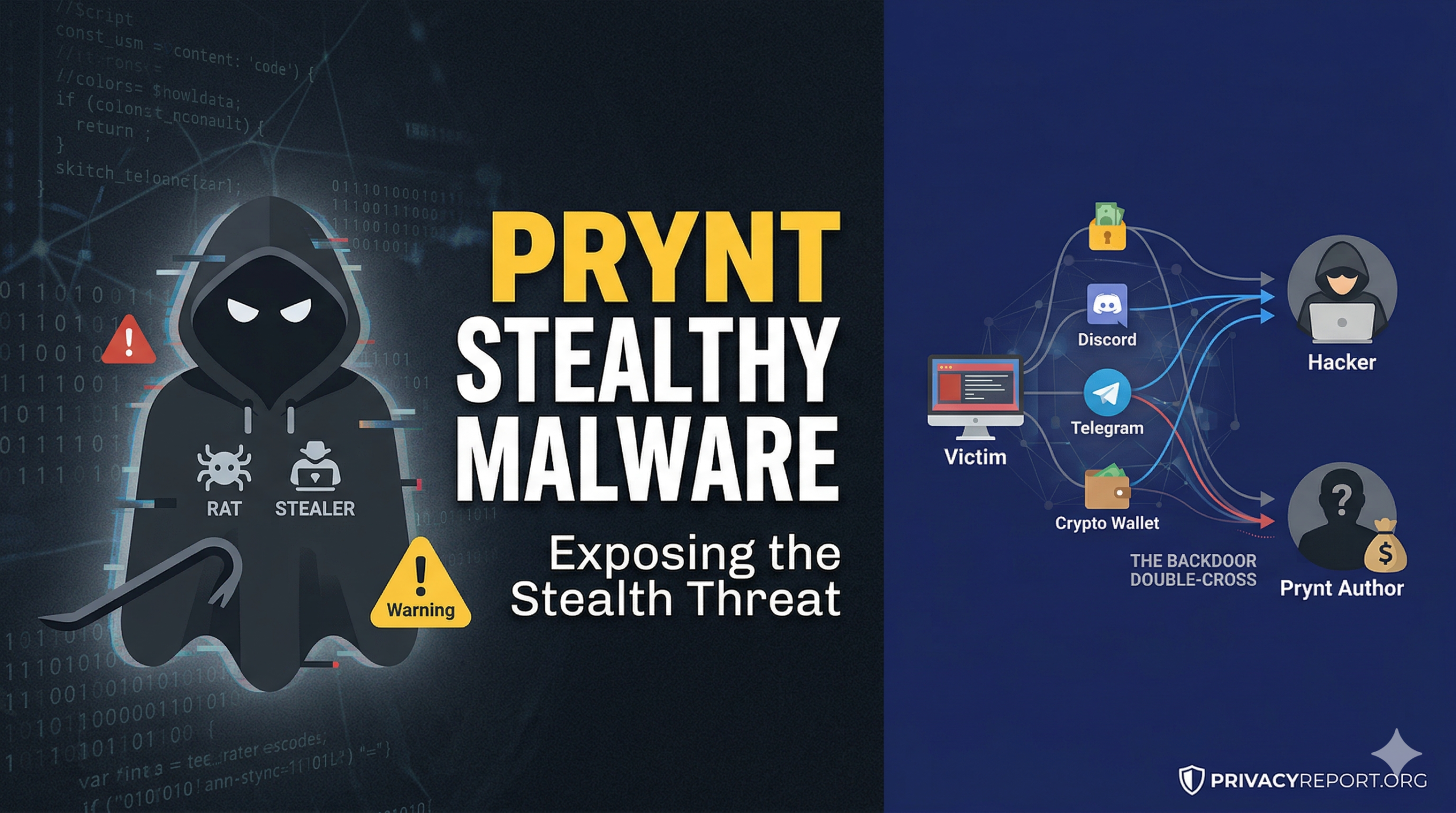
In the evolving cybercrime landscape of 2026, the rise of “Malware-as-a-Service” has led to the proliferation of highly sophisticated information stealers. Among these, Prynt stealthy malware has emerged as a significant threat, distinguishing itself through a complex lineage of open-source code and advanced obfuscation techniques designed to bypass modern security protocols.
Much like the invisible tracking methods used by modern surveillance systems, the Prynt stealthy malware operates in the shadows, often bypassing standard security checks by mimicking legitimate system processes.
1. Evolution and Lineage of the Prynt Framework
The Prynt stealthy malware is not a standalone creation but a sophisticated hybrid “fork” of two well-known malicious projects: AsyncRAT and StormKitty.
- AsyncRAT Integration: Provides the core framework for remote administration, allowing attackers to monitor and control infected systems through encrypted connections.
- StormKitty Modules: Contributes specialized harvesting tools designed to steal credentials from web browsers, messaging apps, and crypto wallets.
This modular design allows Prynt to move beyond simple data theft, facilitating long-term persistence and “hands-on-keyboard” activity by threat actors.
2. Advanced Evasion and Stealth Mechanisms
What makes Prynt stealthy malware particularly dangerous is its multi-layered defense evasion system. Before initiating its malicious routine, the malware audits its environment to ensure it is not being analyzed in a security sandbox.
Key Stealth Tactics:
- Environmental Fingerprinting: The malware checks processor types, memory parameters, and searches for drivers associated with virtualization tools like VMware or VirtualBox.
- Process Injection: Prynt often targets legitimate Windows utilities like
AppLaunch.exe. By injecting its code into a trusted process, it inherits the system’s trust and bypasses many security alerts. - Fileless Loading: Utilizing the
.NETframework, the final payload is often decoded and loaded directly into memory, meaning it never creates a physical file on the hard drive for traditional antivirus scanners to find.
| Step | API Function | Technical Purpose |
| 1 | CreateProcessA | Launches a trusted process in a suspended state. |
| 2 | WriteProcessMemory | Writes the malicious Prynt payload into the allocated memory space. |
| 3 | NtResumeThread | Resumes the thread, executing the malware under a legitimate guise. |
3. Information Harvesting Capabilities
The primary goal of Prynt stealthy malware is the exhaustive collection of sensitive digital assets. It performs a comprehensive sweep of over 30 Chromium-based browsers and multiple messaging platforms.
- Browser Exploitation: Targets “Local State” files to extract master keys and decrypt saved passwords, cookies, and autofill data.
- Cryptocurrency “Clipper”: A sophisticated background module monitors the system clipboard for crypto addresses. When a match is found, it replaces the victim’s address with one controlled by the attacker.
- Application Theft: Extracts session data from Telegram, Discord tokens, and login credentials from VPN and FTP clients like NordVPN and FileZilla.
4. The “Double-Cross” Backdoor
Perhaps the most unique aspect of Prynt stealthy malware is its predatory relationship with its own operators. The malware builder is backdoored by its original developer.
Whenever the malware exfiltrates stolen data to a “customer’s” Telegram channel, a second copy of that data is simultaneously sent to a private channel controlled by the Prynt author. This allows the author to monetize the data twice: once by selling the tool and again by siphoning off the most valuable credentials collected by their clients.
5. Detection and Mitigation Strategies
Combating a threat like Prynt stealthy malware requires a defense-in-depth strategy.
- Isolate and Analyze: Disconnect infected hosts immediately and reboot into Safe Mode to halt malicious threads.
- Global Identity Reset: Because Prynt steals session tokens and cookies, simply changing passwords is not enough. You must revoke all active sessions for every account to invalidate stolen tokens.
- Hardware-Backed MFA: Transitioning to physical security keys (like YubiKey) provides a robust defense against the session hijacking techniques used by modern stealers.
External Technical Resources
For those looking for deeper forensic indicators and detection rules, refer to these professional resources:
- Infoblox Threat Intelligence: Detailed analysis of Prynt Stealer RAT.
- Zscaler Security Research: Exposing the Prynt Stealer Backdoor.
- Cyfirma Forensic Deep Dive: Process Injection Techniques of Infostealers.
3. Conclusion
The emergence of Prynt stealthy malware highlights a dangerous trend in cybercrime: the “Double-Cross.” Not only are users at risk from the malware itself, but even the attackers are being exploited by the software’s creators. For anyone concerned with digital privacy, the lesson is clear—relying on basic antivirus is no longer enough. Protecting your data in 2026 requires a combination of hardware-based MFA, cautious browsing habits, and a deep understanding of the stealthy threats lurking in the digital shadows.
2. Frequently Asked Questions (FAQs)
Q1: Is Prynt stealthy malware a virus or a RAT? Ans: It is both. It acts as an Infostealer to grab your passwords and a RAT (Remote Access Trojan) to give hackers total control over your camera and files.
Q2: How does Prynt malware infect a computer? Ans: Usually through “cracked” software, fake game mods, or phishing emails. It often hides inside a file that looks like a legitimate .exe installer.
Q3: Can my Antivirus detect Prynt stealthy malware? Ans: Many standard antiviruses miss it because it uses Process Injection. It hides its code inside “safe” Windows apps like AppLaunch.exe to stay invisible.
Q4: What should I do if I am infected? Ans: Disconnect from the internet immediately. Change all passwords from a different clean device and “Log out of all sessions” on Google, Discord, and Telegram.
Q5: Is it true the Prynt author steals from the hackers? Ans: Yes. The malware has a “backdoor” that sends a copy of all stolen data to the original creator, essentially stealing from the person who bought the malware.

Abdullah Zulfiqar is a cybersecurity and application security writer at PrivacyReport.org, where he focuses on AI-driven security, privacy protection, and SaaS application risk analysis. His work explores how modern AI systems and digital platforms handle sensitive user data, with a strong emphasis on identifying vulnerabilities, preventing data leaks, and improving software security practices.
He writes about the intersection of artificial intelligence and cybersecurity, helping readers and developers understand emerging threats in AI-powered applications and how to build more secure, privacy-respecting systems.
Leave a Reply