
Entry level cybersecurity jobs are one of the few corners of the tech industry where demand still outpaces supply by a wide margin, and 2026 looks like a good year to take advantage of that. Companies of every size, from regional banks to small e-commerce shops, need people who can watch their networks, spot suspicious activity, and keep customer data safe. Many of them are willing to train someone who shows up with curiosity and a basic foundation rather than wait months for a “perfect” candidate who may never apply.
This guide is written for people who are starting from zero or close to it. Maybe you’re switching careers from retail, the military, teaching, or general IT support. Maybe you just finished a bootcamp or a degree and you’re not sure what to do next. Either way, the goal here is to walk through what entry level cybersecurity jobs actually look like, what skills and certifications matter, what they pay, and how to land your first one without wasting a year chasing the wrong advice.
What Are Entry Level Cybersecurity Jobs?
Entry level cybersecurity jobs are roles designed for people with little or no prior hands-on security experience. They usually involve monitoring, documentation, and supporting more senior analysts rather than making high-stakes decisions on your own. Think of them as the training ground where you learn how real organizations actually defend themselves, as opposed to how it’s described in a textbook.
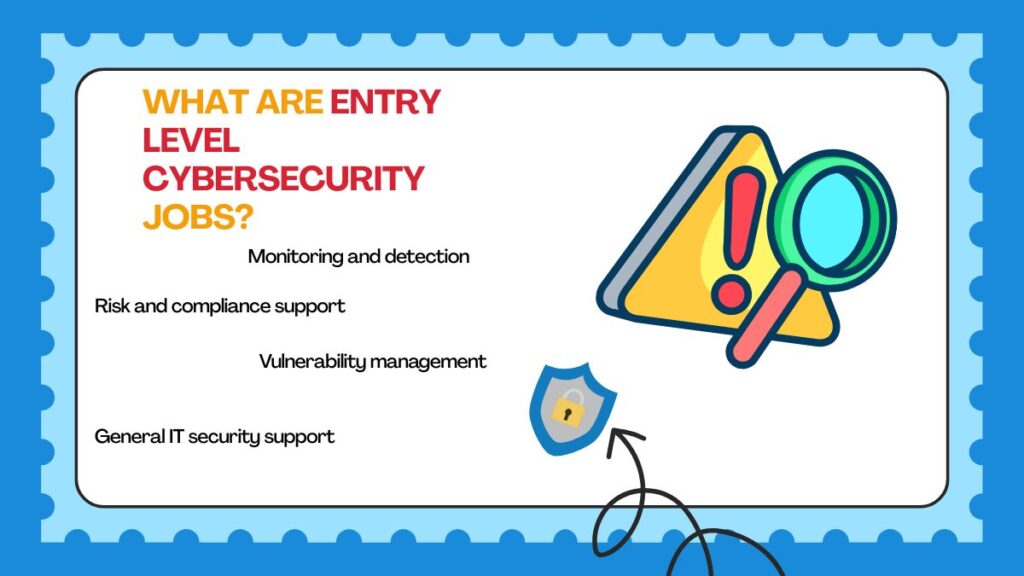
Most of these roles fall into a handful of buckets:
- Monitoring and detection — watching dashboards and alerts for signs of an attack
- Risk and compliance support — helping document policies and check that systems meet regulations
- Vulnerability management — scanning systems for known weaknesses and tracking fixes
- General IT security support — managing user access, patching, and basic security administration
A typical day might involve reviewing a batch of automated alerts, deciding which ones deserve a closer look, writing up a short report, and asking a senior teammate questions when something doesn’t make sense. It’s detail-oriented work, and it rewards people who are methodical rather than people looking for constant excitement.
It’s worth knowing that “entry level” in cybersecurity doesn’t always mean zero experience. Some postings labeled entry level still ask for a year or two of general IT work, which is a separate frustration we’ll cover later. But genuine on-ramps do exist, and they’re more common than the job boards sometimes suggest.
Why Cybersecurity Is a Great Career in 2026
The short version: there simply aren’t enough qualified people to fill the open positions. According to CyberSeek, a workforce data tool backed by the National Institute of Standards and Technology, there were more than 514,000 unfilled cybersecurity positions across the United States in the most recent reporting period. That gap has been growing for years, not shrinking.
A few reasons this career path holds up well compared to other tech roles:
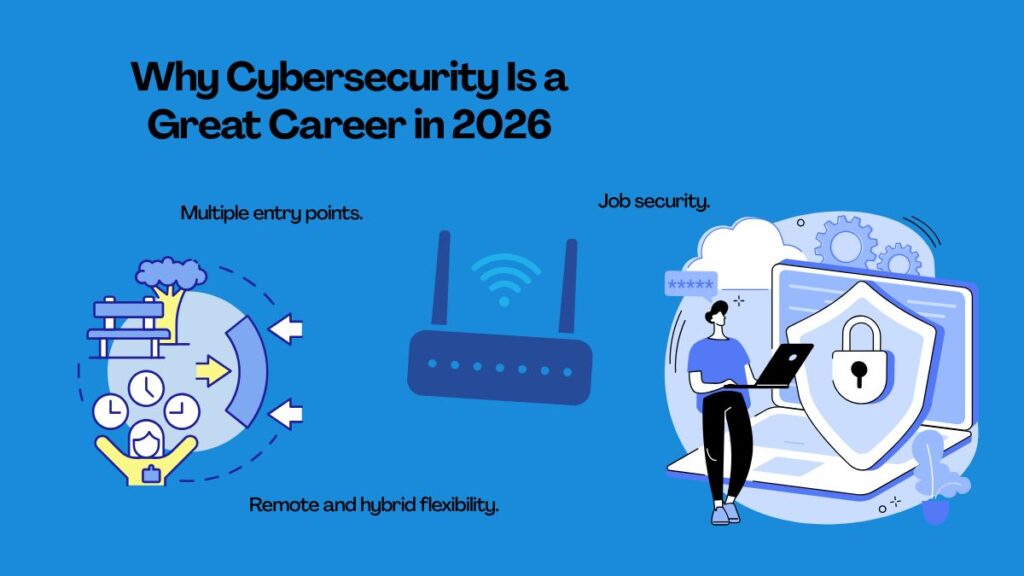
- Job security. Security teams are rarely the first ones cut during layoffs, because the risk of operating without them is too high.
- Strong long-term growth. The U.S. Bureau of Labor Statistics projects employment for information security analysts to grow 29 percent from 2024 to 2034, which is much faster than the average for all occupations.
- Multiple entry points. You don’t need a four-year computer science degree. Certifications, hands-on labs, and relevant IT experience can all open doors.
- Remote and hybrid flexibility. A meaningful share of cybersecurity roles, especially monitoring positions, can be done from home.
None of this means the job hunt will be easy. Hiring managers are still selective, and “entry level” postings sometimes ask for unrealistic experience. But the underlying demand is real, and it isn’t going away anytime soon.
Skills Needed for Entry Level Cybersecurity Jobs
Technical Skills
You don’t need to know everything before you apply, but a working foundation makes you a far stronger candidate.
- Networking basics. Understand how IP addresses, DNS, firewalls, and VPNs work. You’ll see these concepts constantly.
- Operating system fundamentals. Comfort with both Windows and Linux command lines goes a long way.
- Log analysis. Knowing how to read logs and spot anomalies is at the heart of most monitoring roles.
- Familiarity with common cybersecurity tools. SIEM platforms like Splunk or Microsoft Sentinel, vulnerability scanners like Nessus, and ticketing systems are things most teams expect you to pick up quickly, even if you’ve only practiced on free or trial versions.
- Basic scripting. Simple Python or PowerShell scripts can help you automate repetitive tasks, which hiring managers notice.
A lot of newcomers spend their first few months experimenting with home setups before they ever apply for a job. It’s common to start by exploring online privacy tools and free network monitors at home just to see how traffic, encryption, and access controls behave from the inside, before doing the same work professionally on someone else’s network.
Soft Skills
Technical knowledge gets you in the door, but soft skills are what keep hiring managers interested.
- Clear written communication. You’ll be writing incident summaries and reports that non-technical people need to understand.
- Attention to detail. Missing a small anomaly in a log file can mean missing an actual breach.
- Curiosity and a willingness to keep learning. Threats change constantly, and so do the tools used to fight them.
- Calm under pressure. Security incidents are stressful by nature, and panic doesn’t help anyone.
Best Entry Level Cybersecurity Roles
Not every cybersecurity job is open to beginners, but several genuinely are. Here are the ones worth targeting first.
SOC Analyst (Tier 1). This is the most common starting point for entry level cybersecurity jobs. SOC stands for Security Operations Center, and a Tier 1 analyst is the first line of defense. You’ll spend your shift on network security monitoring dashboards, reviewing alerts from a SIEM tool, deciding which ones are real threats versus false positives, and escalating anything serious to a senior analyst. It’s repetitive at first, but it teaches you how real attacks actually unfold.
IT Security Specialist. This role blends general IT support with a security focus: managing user access, patching systems, configuring firewalls, and handling day-to-day security tickets. Some specialists also get involved in spotting unusual remote connections, which is where tools like VPN detection tools and even a VPN detection API come into play, since many organizations rely on automated systems to flag traffic that’s being routed through anonymizing services before it reaches their network.
Junior GRC (Governance, Risk, and Compliance) Analyst. This path is more documentation-heavy. You’ll help with risk assessments, review how systems are configured against frameworks like HIPAA or PCI-DSS, and assist with audits. Organizations in healthcare, finance, and government hire heavily here because of strict regulatory requirements.
Vulnerability Analyst / Security Technician. Your job is to run vulnerability scans across the organization’s systems, review the results, and prioritize what needs fixing. It’s methodical work and a solid stepping stone toward penetration testing later in your career.
Help Desk with a Security Track. Plenty of people enter cybersecurity sideways through general help desk or desktop support roles, then move into a dedicated security team once they’ve built internal credibility and a track record.
Education and Certifications Required
You generally do not need a four-year degree to land entry level cybersecurity jobs, though a degree can help with government and cleared contractor positions where academic credentials still matter during screening. What employers care about most is whether you can demonstrate real, applicable skills.
Certifications are the fastest way to prove that. A few stand out for beginners:
- CompTIA Security+ — widely considered the standard first certification for cybersecurity. It covers threats, network security, cryptography basics, and risk management, and it appears in a large share of entry level job postings.
- ISC2 Certified in Cybersecurity (CC) — a genuinely beginner-friendly certification with no work experience requirement, designed specifically for people just starting out.
- CompTIA Network+ — useful if your networking fundamentals are shaky, since it builds the base that Security+ assumes you already have.
- Google Cybersecurity Certificate — a more affordable, self-paced option that some employers now recognize as a legitimate signal of foundational knowledge.
It’s also worth getting familiar with the NIST Cybersecurity Framework. You won’t be expected to master it as a beginner, but many employers structure their security programs around its five core functions: Identify, Protect, Detect, Respond, and Recover. Being able to speak that language in an interview makes a strong impression.
One honest note: certifications open doors, but they don’t replace hands-on practice. Pair any certification with a home lab, a Capture the Flag (CTF) challenge, or a few documented projects so you can talk through real examples in an interview rather than just reciting definitions.
How to Get Your First Cybersecurity Job
Breaking in usually comes down to a handful of deliberate moves rather than luck.
- Build a foundation first. If you’re starting completely fresh, a few months in general IT support or help desk work gives you the troubleshooting reps that make security concepts click faster.
- Get one certification, then apply. Don’t wait until you’ve collected five certifications. CompTIA Security+ or ISC2’s CC is usually enough to start submitting applications seriously.
- Build a small portfolio. Document a home lab project, a CTF you completed, or a write-up of a vulnerability you found in a practice environment. Put it on a simple website or GitHub page and link to it on your resume.
- Tailor your resume to the posting. Mirror the language used in the job description. If they mention specific cybersecurity tools, name them explicitly if you’ve used them, even in a lab setting.
- Apply broadly, including government pathways. CISA’s cybersecurity careers page lists federal opportunities, internships, and student programs that are specifically built for people early in their careers, and similar pathways exist at the state level.
- Network deliberately. Join a local ISC2 or ISACA chapter, show up to a security meetup, or get active in cybersecurity communities on Reddit and LinkedIn. A surprising number of entry level cybersecurity jobs get filled through a referral before they’re ever posted publicly. ISC2’s career resources are a solid starting point for structured guidance and a candidate community built around exactly this stage of the journey.
- Practice interview scenarios. Be ready to explain how you’d triage an alert, what you’d do if you suspected a phishing email, or how you’d explain a basic security concept to someone non-technical.
Common Mistakes Beginners Make
- Waiting for the “perfect” qualifications. Many people delay applying until they’ve stacked four or five certifications. Hiring managers usually care more about demonstrated curiosity and one solid credential than a long list of acronyms.
- Skipping the fundamentals for flashy specializations. It’s tempting to jump straight into ethical hacking content because it looks exciting, but weak networking and operating system basics will show up quickly in an interview.
- Only applying to senior-sounding titles. Some beginners avoid “Tier 1” or “Junior” titles because they sound unimpressive. These are exactly the roles built for newcomers.
- Treating certifications as a substitute for hands-on practice. A certificate proves you can pass a test. A home lab or a documented project proves you can apply the knowledge.
- Ignoring soft skills. Technical knowledge without the ability to explain it clearly in writing or conversation limits how far you’ll get, especially in interviews.
- Not networking at all. Cybersecurity is a relationship-driven field. Sitting back and only submitting online applications usually takes far longer than getting involved in a community.
Salary Expectations
Salaries for entry level cybersecurity jobs vary by role, location, and certifications, but a few patterns hold up consistently across recent industry data.
- Tier 1 SOC Analyst: roughly $50,000 to $75,000, with shift differentials for nights and weekends sometimes pushing total compensation higher.
- IT Security Specialist: roughly $55,000 to $80,000, often higher if you’re bringing existing IT experience.
- Junior GRC Analyst: roughly $60,000 to $85,000, with regulated industries like finance and healthcare paying toward the top of that range.
- Vulnerability Analyst / Security Technician: roughly $60,000 to $85,000 depending on the employer and sector.
Holding a certification like CompTIA Security+ tends to push offers toward the higher end of these ranges, and so does prior IT experience or an active security clearance for government-adjacent work. For context, the U.S. Bureau of Labor Statistics reports a median salary well above $100,000 across all experience levels for information security analysts, which gives you a sense of where the role can lead once you move past the entry stage. The jump from entry level to a Tier 2 or Tier 3 role, typically after one to three years and an additional certification, is usually where the biggest pay increase happens.
Best Resources for Learning Cybersecurity
You don’t need an expensive bootcamp to build real skills. A combination of free and low-cost resources can take a motivated beginner a long way.
- TryHackMe and Hack The Box — guided, hands-on labs that simulate real attack and defense scenarios, ideal for building practical muscle memory.
- Official certification study guides — CompTIA and ISC2 both publish structured material that maps directly to their exams.
- CISA’s NICCS portal — a useful reference for understanding the wide range of cybersecurity job roles defined by the federal government’s own workforce framework.
- Home lab projects — setting up a virtual machine, practicing with a firewall, or building a small monitoring setup teaches more than passive reading ever will.
- Industry blogs and newsletters — following ongoing privacy and security insights helps you stay current on real attacks and trends, which is exactly the kind of context that makes you sound credible in an interview rather than like you only studied for a test.
- Local chapters and online communities — ISC2 and ISACA chapters, plus active subreddits and LinkedIn groups, are full of people who remember exactly what it was like to be in your position.
Frequently Asked Questions
Do I need a degree for entry level cybersecurity jobs?
No, not in most cases. A degree can help with certain government or cleared contractor roles, but the field has shifted toward a skills-first approach. Certifications, hands-on labs, and demonstrable project work carry real weight with most private-sector employers.
How long does it take to get an entry level cybersecurity job?
It varies, but a realistic timeline for someone starting from general IT experience is six to twelve months: a few months earning a certification like Security+, alongside building a small portfolio and actively applying and networking.
Is CompTIA Security+ enough to get hired?
It’s often enough to get your resume seriously considered, especially paired with a home lab or documented project. It’s rarely enough on its own without some way to show you can apply what it covers.
What is the easiest entry level cybersecurity job to get?
Tier 1 SOC analyst and general IT security support roles tend to have the most openings and the most realistic entry requirements, particularly at managed security service providers that hire and train in volume.
Can I switch into cybersecurity from a completely unrelated career?
Yes. Career changers from teaching, the military, retail, and other fields enter the industry regularly. The transition is smoother if you spend a few months building foundational IT knowledge first, since most entry level cybersecurity jobs assume at least basic comfort with how networks and systems work.
Are cybersecurity jobs at risk from AI automation?
Some routine monitoring tasks are increasingly assisted by AI tools, but this has mostly shifted demand toward people who can interpret and manage those tools rather than eliminating entry level roles outright. The broader talent shortage means demand for capable beginners remains strong.
Conclusion
Entry level cybersecurity jobs are one of the most realistic ways to build a stable, well-paying career in tech without needing a traditional four-year degree. The path is straightforward even if it isn’t fast: build foundational IT knowledge, earn a recognized certification like CompTIA Security+, get hands-on practice through labs or projects, and apply consistently while networking inside the community. The skills shortage isn’t closing anytime soon, which means the door is genuinely open for people willing to put in the work to walk through it.
If you want to keep building your understanding of digital security beyond the job hunt itself, the team at PrivacyReport.org regularly covers the tools, threats, and trends shaping the industry, which is useful reading whether you’re studying for your first certification or just trying to understand the field you’re about to enter.

I am a dedicated SEO Expert and Content Specialist with a passion for driving organic growth. With a deep understanding of link building, domain metrics, and on-page optimization, I help brands bridge the gap between technical search requirements and engaging user experiences. Whether it’s crafting SEO-optimized articles or managing complex backlink strategies, my goal is always the same: sustainable, high-ranking results.
Leave a Reply