
TitanHQ AI safety tools evaluation is the starting point for any organization, managed service provider, or IT decision-maker trying to determine whether TitanHQ belongs in their cybersecurity stack. TitanHQ is an Irish cybersecurity company founded in 1999, headquartered in Galway, that has built a cloud-delivered security portfolio centered on email protection, web filtering, and anti-phishing defense. Over recent years, they have integrated artificial intelligence and machine learning across their core products — SpamTitan, PhishTitan, and WebTitan — to improve threat detection accuracy and reduce manual IT workload. This evaluation covers exactly what their AI tools do, where they perform strongly, where their boundaries lie, and which organizations they are best suited for.
The short answer to whether TitanHQ is a credible AI safety tool provider: yes, with important qualifications. Their AI implementation is practical and effective within their defined product scope, but organizations with complex enterprise security needs or highly specialized threat environments should understand the boundaries of what TitanHQ’s AI tools are designed to do.
Company Background: Who Is TitanHQ?
TitanHQ was founded in 1999 and is headquartered in Galway, Ireland. The company has spent over two decades building cloud-delivered security solutions with a particular focus on the SMB market and the managed service provider channel.
Their product portfolio centers on three primary platforms: SpamTitan for email security, WebTitan for DNS and web content filtering, and ArcTitan for email archiving. They also offer PhishTitan, a dedicated anti-phishing solution that represents their most AI-forward product to date.
TitanHQ serves tens of thousands of businesses globally, operating primarily through an MSP model where managed service providers deploy TitanHQ solutions to their end-client base. This distribution model has practical implications for how their AI tools are configured and managed in real-world deployments.
How TitanHQ Uses AI Across Its Product Suite
AI in SpamTitan: Email Threat Detection
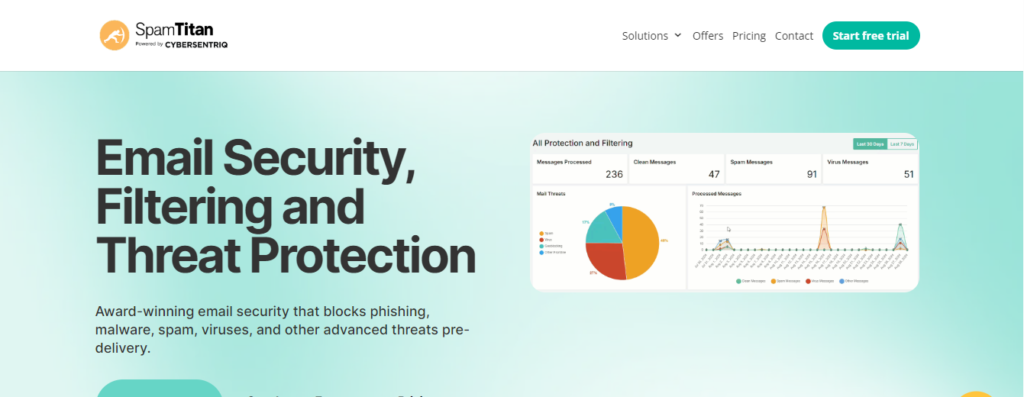
SpamTitan is TitanHQ’s flagship email security product, and it is where their AI and machine learning investment is most mature and most visible.
The platform uses a multi-layered detection approach that combines traditional signature-based filtering with machine learning models trained to detect behavioral patterns associated with spam, phishing, malware delivery, and business email compromise attempts.
Key AI-driven capabilities within SpamTitan include:
- Predictive threat scoring — Each incoming email receives a threat score generated by machine learning models that evaluate sender reputation, message content patterns, link behavior, attachment characteristics, and header anomalies simultaneously
- Zero-day threat detection — Rather than relying purely on known threat signatures, the AI models analyze behavioral patterns to catch novel threats that have not yet been catalogued in threat intelligence databases
- Sandboxing integration — Suspicious attachments are detonated in an isolated environment, with AI analysis applied to the behavioral output to determine malicious intent
- Impersonation detection — Machine learning models trained specifically on business email compromise patterns detect display name spoofing, domain lookalikes, and executive impersonation attempts with higher accuracy than rule-based filters alone
In independent testing and user-reported evaluations, SpamTitan’s catch rate for spam and phishing is consistently reported above 99.9%, which places it competitively among enterprise-grade email security solutions.
AI in PhishTitan: The Most AI-Forward Product
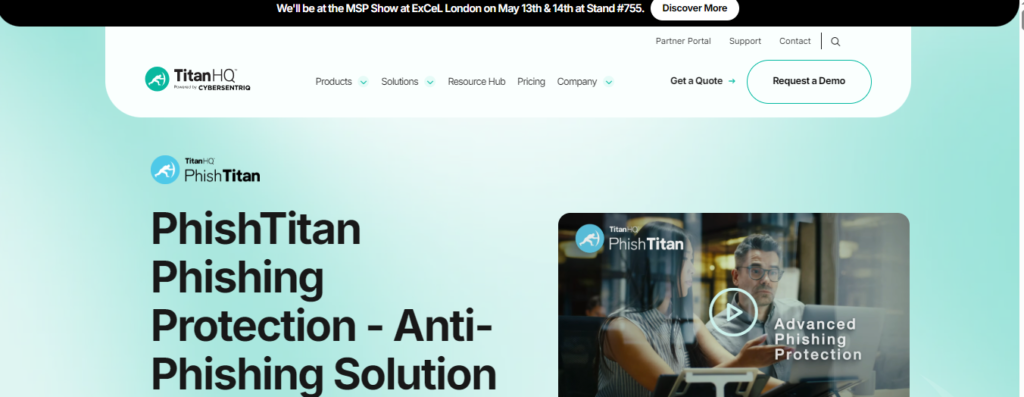
PhishTitan is TitanHQ’s dedicated anti-phishing solution and represents their most explicit application of large language model and AI-based analysis to cybersecurity.
PhishTitan uses natural language processing to analyze the content and intent of suspicious emails at a linguistic level, going beyond structural pattern matching to understand the persuasive and deceptive techniques that characterize sophisticated phishing attacks.
The platform’s AI capabilities include:
- Intent analysis — NLP models evaluate whether the language in an email is attempting to create urgency, impersonate authority, or manipulate recipients into taking specific actions such as clicking a link or transferring funds
- Brand impersonation detection — AI models trained on legitimate brand communication patterns can identify emails that mimic trusted organizations even when visual spoofing is subtle and domain manipulation is sophisticated
- Link analysis at scale — Every URL in a suspicious email is analyzed using AI models that evaluate destination page behavior, redirect chains, and content to identify credential harvesting pages and malware landing sites in real time
- Time-of-click protection — Because phishing links can be benign at the time of delivery and malicious at the time of clicking, PhishTitan’s AI continues to evaluate links at the moment users attempt to access them
This approach addresses one of the most significant weaknesses in traditional email security: the time gap between delivery and interaction during which threat actors can activate malicious infrastructure.
AI in WebTitan: DNS Filtering and Web Safety
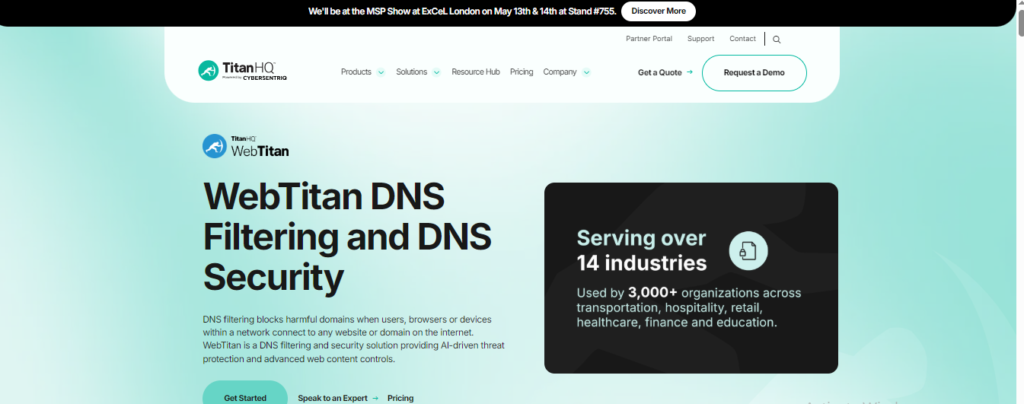
WebTitan applies AI-assisted threat intelligence to DNS filtering, blocking access to malicious websites, inappropriate content categories, and newly registered domains that exhibit high-risk behavioral patterns.
The AI component in WebTitan primarily supports:
- Threat intelligence enrichment — Machine learning models continuously analyze domain registration data, traffic patterns, and behavioral signals to categorize newly appearing domains before traditional blacklists can catalogue them
- Content categorization — AI-assisted categorization of web content allows for more granular and accurate filtering policy enforcement across a broader range of websites than static category lists can cover
- Anomaly detection — Unusual DNS query patterns that may indicate malware command-and-control communication are flagged for administrator review
WebTitan’s AI capabilities are less prominently positioned than those in SpamTitan and PhishTitan, but they contribute meaningfully to reducing the risk of web-based threat delivery.
Evaluating TitanHQ’s AI Safety Tools: Key Strengths
Strength 1: Practical AI Implementation for Real-World Deployments
One of the most common criticisms of AI-powered cybersecurity tools is that they deliver impressive benchmark performance but prove difficult to deploy, configure, and maintain in real-world environments. TitanHQ largely avoids this problem.
Their AI tools are embedded into cloud-delivered products that are designed for MSP-managed deployments where simplicity, consistency, and low administrative overhead are critical. The AI works in the background without requiring administrators to configure machine learning models or tune detection thresholds manually.
This practical approach makes TitanHQ’s AI safety tools genuinely accessible to organizations that do not have dedicated data science or advanced cybersecurity teams.
Strength 2: Strong Performance Against Phishing and Email-Based Threats
Email-based threats remain the primary attack vector for the vast majority of cybersecurity incidents, and TitanHQ’s AI capabilities are most deeply developed in exactly this area.
Their combination of machine learning-based behavioral analysis, NLP-driven intent detection in PhishTitan, and time-of-click link verification addresses the threat landscape at multiple layers, giving organizations meaningful protection against both commodity phishing attacks and more targeted spear phishing campaigns.
Strength 3: MSP-Optimized Architecture
For managed service providers evaluating AI safety tools to deploy across their client base, TitanHQ’s multi-tenant architecture, centralized management console, and white-labeling capabilities make it one of the most MSP-friendly platforms in the market.
The AI models in their products are maintained and updated centrally by TitanHQ, meaning MSPs benefit from continuous improvement in detection capability without needing to manage model updates or retraining cycles themselves.
Strength 4: Transparent Reporting and Visibility
AI-driven security tools are sometimes criticized for being black boxes that provide little insight into why specific decisions were made. TitanHQ offers detailed reporting dashboards that allow administrators to see what threats were detected, how they were classified, and what actions were taken.
This transparency is important both for organizational compliance purposes and for building confidence in the AI-driven detection systems among IT leadership and end users.
Strength 5: Competitive Pricing for the SMB and MSP Market
TitanHQ’s AI safety tools are priced significantly below enterprise cybersecurity platforms that offer broadly comparable AI-driven email and web security capabilities. For SMBs and MSP clients operating with constrained security budgets, this pricing structure allows meaningful AI-assisted threat protection without the cost overhead of enterprise vendors.
Evaluating TitanHQ’s AI Safety Tools: Limitations and Considerations
Limitation 1: Narrow Product Scope
TitanHQ’s AI capabilities are concentrated in email security, DNS filtering, and web content protection. Organizations looking for AI-assisted endpoint detection and response, security information and event management, user behavior analytics, cloud workload protection, or network traffic analysis will not find those capabilities within TitanHQ’s portfolio.
TitanHQ is a specialist vendor, not a full-spectrum security platform. Evaluating them requires understanding this scope clearly.
Limitation 2: Enterprise Feature Gaps
Larger organizations with complex security requirements, dedicated security operations centers, advanced compliance frameworks, or sophisticated threat hunting programs will likely find TitanHQ’s reporting, integration, and customization capabilities insufficient for their needs.
The platform is designed for the SMB and MSP market, and that design philosophy prioritizes simplicity and accessibility over the depth and configurability that enterprise security teams require.
Limitation 3: AI Model Transparency
While TitanHQ provides meaningful reporting on threat detections, they do not publish detailed documentation of their underlying machine learning architectures, training data methodologies, or model performance benchmarks in the way that some security vendors do.
For organizations that require rigorous AI model auditability for regulatory or governance purposes, this limited transparency may present challenges.
Limitation 4: Integration Ecosystem
TitanHQ integrates with major Microsoft and Google productivity platforms and offers API access, but their integration ecosystem is narrower than that of larger cybersecurity platforms. Organizations with complex SIEM environments, advanced orchestration workflows, or specialized security tools may find integration development more demanding than with vendor alternatives.
TitanHQ vs. Competing AI Cybersecurity Vendors
When evaluating TitanHQ’s AI safety tools, it is useful to understand where they sit in the competitive landscape.
Against vendors like Proofpoint and Mimecast in the email security space, TitanHQ competes primarily on price and MSP accessibility rather than on depth of AI capability or breadth of threat intelligence. Proofpoint and Mimecast have significantly larger threat intelligence datasets and more extensive enterprise feature sets, but they are also significantly more expensive and more complex to manage.
Against Microsoft Defender for Office 365, TitanHQ offers an independent layer of email security that many MSPs deploy as a complement to or replacement for Microsoft’s native protection, arguing that dedicated email security vendors maintain more specialized and rapidly updated AI threat models than those bundled into broader productivity platforms.
Against web filtering competitors like Cisco Umbrella and Zscaler, WebTitan competes on simplicity and price, with Umbrella and Zscaler offering more sophisticated AI threat intelligence capabilities and broader network security coverage at significantly higher price points.
The appropriate conclusion is that TitanHQ occupies a distinct and well-defined market position as a high-value, practically implemented AI security tool provider for the SMB and MSP segment, rather than a competitor to enterprise security platforms.
Real-World Use Cases Where TitanHQ AI Safety Tools Perform Well
Understanding where TitanHQ delivers strongest real-world value helps set appropriate expectations for any evaluation.
Managed service providers deploying security solutions to small and medium business clients will find TitanHQ’s multi-tenant architecture, white-labeling, and centralized AI-managed threat protection well suited to their operational model.
Healthcare and education organizations with significant phishing exposure and compliance requirements around email and web safety benefit from TitanHQ’s focused protection in these high-risk communication channels.
Legal and financial services SMBs handling sensitive client information benefit from SpamTitan’s business email compromise detection and PhishTitan’s impersonation protection, where AI-driven intent analysis catches attacks that rule-based filters miss.
Organizations replacing legacy on-premise email security appliances with cloud-delivered alternatives will find TitanHQ’s cloud-native architecture and managed AI models a straightforward migration path.
Deployment and Onboarding: What to Expect
TitanHQ’s cloud-delivered model means deployment is significantly faster than traditional on-premise security solutions. SpamTitan can typically be deployed via MX record changes in a matter of hours. WebTitan DNS filtering is activated by redirecting DNS queries through TitanHQ’s resolvers.
The AI models are pre-configured and operational from deployment day one, without requiring training periods on organizational-specific data. This is a practical advantage for organizations that need protection operational quickly, though it also means the AI is not customized to specific organizational communication patterns in the way that some more expensive solutions allow.
Ongoing management is handled through TitanHQ’s web-based administrative console, with the AI operating autonomously in the background and surfacing threats and reports through the dashboard interface.
Summary Verdict: Is TitanHQ Worth It for AI-Powered Cybersecurity?
TitanHQ delivers genuine, practically implemented AI safety tools in the domains of email security, anti-phishing, and web content filtering. Their AI capabilities are not superficial marketing claims but reflect substantive machine learning and NLP investment that translates into measurable detection performance in real deployments.
For the market they serve — managed service providers, SMBs, healthcare, education, and organizations that need effective AI-assisted threat protection without the complexity and cost of enterprise platforms — TitanHQ represents strong value and credible capability.
The evaluation verdict organized by organization type:
- MSPs and SMBs — Strongly recommended as a primary or complementary email and web security layer
- Mid-market organizations — Recommended with the caveat that supplementary security tools will be needed for endpoint, network, and behavioral threat coverage
- Large enterprises — Not the primary recommendation; evaluate alongside or in favor of enterprise-grade platforms unless budget constraints make TitanHQ’s price point compelling for specific use cases
- Organizations with advanced compliance requirements — Evaluate carefully against AI auditability and reporting requirements before committing
TitanHQ is a cybersecurity company that has used AI thoughtfully within a focused product scope rather than bolting artificial intelligence superficially onto legacy tools. That focused, practical approach is both their greatest strength and the clearest explanation of where their AI safety tools excel and where their boundaries lie.

Leave a Reply