
Whether you are preparing for a data privacy compliance assessment or designing a data pipeline for a modern SaaS product, understanding which action upholds a privacy principle is essential.
Privacy principles are often written in broad legal language across global regulations like the European Union’s General Data Protection Regulation (GDPR), the California Consumer Privacy Act (CCPA/CPRA), the OECD Privacy Guidelines, and the US Fair Information Practice Principles (FIPPs). However, privacy principles only protect real people when translated into concrete day-to-day decisions, system configurations, and business practices.
This guide provides both the direct answer to standard compliance scenarios and a comprehensive operational framework for organizations, developers, and compliance teams seeking to build privacy-first systems.
The Direct Answer: Which Action Upholds a Privacy Principle?
In standard privacy training and compliance tests, questions frequently contrast a single compliant action against several everyday bad practices.
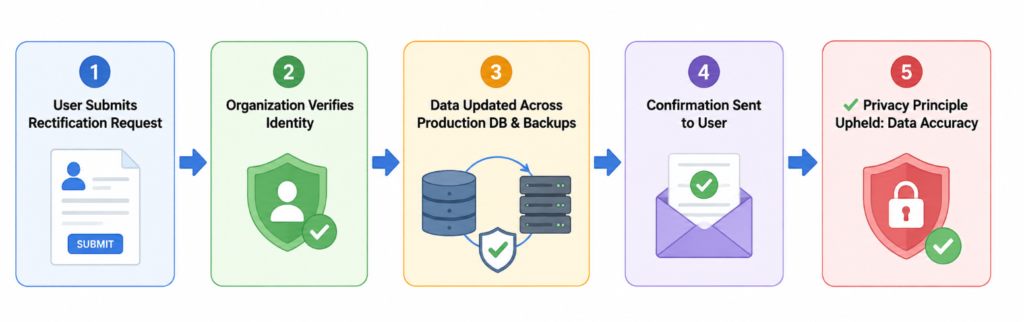
- The Compliant Action: Correcting personal information when requested by an individual.
- The Privacy Principle It Upholds: Data Accuracy (Data Quality).
Why Other Common Actions Fail
To understand why correcting records is the correct action, consider why the alternative actions fail:
- “Collecting as much personal data as possible for future opportunities”: Violates the principle of Data Minimization, which mandates that organizations only gather information strictly necessary for a stated purpose.
- “Retaining customer records indefinitely in case they return”: Violates the principle of Storage Limitation, which requires data to be deleted or anonymized once its primary purpose is completed.
- “Sharing user emails with a third-party partner without clear disclosure”: Violates the principles of Purpose Limitation and Transparency, which forbid repurposing data for unannounced secondary uses.
The Master Privacy Principles Action Matrix
Global data protection standards—including GDPR Article 5 and the OECD Privacy Guidelines—are organized around seven core principles. The table below illustrates how specific actions either uphold or violate each principle.
| Core Privacy Principle | Primary Statutory Reference | Action That Upholds the Principle | Action That Violates the Principle |
|---|---|---|---|
| 1. Data Accuracy (Data Quality) | GDPR Art. 5(1)(d); OECD Principle 2; CCPA § 1798.106 | Updating outdated records promptly upon user request; providing self-service profile edit tools. | Continuing to process inaccurate credit or address records after receiving a correction notice. |
| 2. Data Minimization (Collection Limitation) | GDPR Art. 5(1)(c); OECD Principle 1; FIPPs Notice/Choice | Collecting only an email address for a newsletter sign-up rather than demanding full names, phone numbers, and job titles. | Requiring users to provide their national ID or physical address to read a public blog post. |
| 3. Purpose Limitation (Purpose Specification) | GDPR Art. 5(1)(b); OECD Principle 3 & 4 | Processing customer shipping addresses solely to deliver orders and deleting them from temporary routing queues. | Enrolling customers who made a one-time purchase into an unrelated behavioral ad-targeting database without consent. |
| 4. Storage Limitation (Retention Period) | GDPR Art. 5(1)(e); FIPPs Retention Standards | Setting automated database purge jobs to remove expired account data 30 days after contract termination. | Storing historical server access logs containing raw IP addresses and user identifiers indefinitely. |
| 5. Lawfulness, Fairness & Transparency | GDPR Art. 5(1)(a); OECD Principle 6 (Openness); FIPPs Notice | Displaying clear, plain-English privacy notices and requiring active, un-checked opt-in consent. | Using hidden checkmarks, deceptive interface designs (dark patterns), or burying data-sharing clauses in dense legalese. |
| 6. Integrity & Confidentiality (Security Safeguards) | GDPR Art. 5(1)(f); OECD Principle 5; NIST Privacy Framework | Encrypting databases at rest, enforcing multi-factor authentication (MFA), and scanning code for exposed secrets. | Hardcoding API credentials into public repositories or transmitting customer passwords over unencrypted HTTP. |
| 7. Accountability (Governance & Verification) | GDPR Art. 5(2); OECD Principle 8; ISO/IEC 27701 | Documenting Records of Processing Activities (ROPA), conducting DPIAs, and running automated security scans. | Operating data pipelines without documented workflows, data flow maps, or audit trails. |
In-Depth Analysis: How to Uphold Each Privacy Principle
Understanding how to translate these principles into practical, auditable operations requires looking at each principle individually.
1. The Principle of Data Accuracy (Data Quality)
The principle of accuracy states that personal data must be accurate and, where necessary, kept up to date. Organizations must take every reasonable step to ensure that inaccurate data is erased or rectified without delay.
Actions That Uphold Data Accuracy:
- Providing Self-Service Portals: Allowing customers to view and update their profile details, billing addresses, and communication preferences directly.
- Establishing Identity-Verified Correction Workflows: Promptly executing Data Subject Access Requests (DSARs) for rectification across primary databases, downstream data warehouses, and third-party SaaS tools.
- Periodic Validation Routines: Running automated verification routines to bounce invalid contact information and verify data freshness before critical operations.
Illustrative Example:
A customer notices that their billing address contains an outdated postal code and submits a change request via a support ticket. An operations team upholding the accuracy principle updates the production database within 48 hours and propagates the update to the connected invoicing and logistics systems.
Actions That Violate Data Accuracy:
- Ignoring rectification tickets submitted by users.
- Making automated credit or eligibility decisions based on stale, unverified database records.
2. The Principle of Data Minimization (Collection Limitation)
Data minimization requires that personal data must be adequate, relevant, and limited to what is strictly necessary in relation to the purposes for which it is processed.
Actions That Uphold Data Minimization:
- Streamlining Web Forms: Trimming registration and lead-capture forms to only the data fields essential for completing the immediate transaction.
- Sanitizing API Payloads: Returning only the specific JSON fields requested by a client application instead of dumping entire database user objects.
- Pseudonymizing Analytical Records: Stripping names, IP addresses, and unique identifiers before feeding event logs into product analytics platforms.
TIP
If your application is exposing unnecessary user records or sensitive tokens in API responses, utilizing an automated privacy leak detector can help your engineering team flag and eliminate exposed data fields before production deployments.
Actions That Violate Data Minimization:
- Requesting social security numbers or phone numbers when a user signs up for a digital newsletter.
- Capturing comprehensive device telemetry and location data when the application only provides a basic text editing service.
3. The Principle of Purpose Limitation (Purpose Specification)
Purpose limitation dictates that personal data must be collected for specified, explicit, and legitimate purposes and not further processed in a manner that is incompatible with those original purposes.
Actions That Uphold Purpose Limitation:
- Explicit Purpose Disclosure: Clearly informing users at the point of collection exactly why their data is needed (e.g., “Your email address will be used exclusively to send order tracking notifications”).
- Segregating Data Stores: Structuring databases so that transactional data (like shipping addresses) cannot be accessed by unauthorized secondary marketing engines.
- Seeking Fresh Consent for New Uses: Requesting opt-in authorization if your organization decides to use historical customer data for a new purpose, such as training generative AI models.
Actions That Violate Purpose Limitation:
- Selling a database of customer phone numbers collected for multi-factor authentication to third-party telemarketing networks.
- Repurposing employee health survey data for performance appraisals.
4. The Principle of Storage Limitation (Retention Limitation)
The storage limitation principle mandates that personal data must be kept in a form that permits identification of data subjects for no longer than is necessary for the purposes for which the personal data is processed.
Actions That Uphold Storage Limitation:
- Automated Data Deletion Policies: Establishing scheduled cron jobs and database retention rules that automatically purge or hard-delete inactive records.
- Data Anonymization and Aggregation: Converting raw transactional records into irreversible aggregated statistics once the active customer relationship concludes.
- Enforcing Ephemeral Logging: Setting server log rotation policies that overwrite or strip IP addresses after 14 to 30 days.
Example Retention Schedule:├── Session Tokens --> Auto-expire after 24 hours of inactivity├── Server Debug Logs --> Rotate and truncate after 14 days├── Customer Invoices --> Retain for statutory tax period (e.g., 7 years), then auto-purge└── Cancelled Accounts --> Anonymize analytics data; hard-delete PII within 30 days
Actions That Violate Storage Limitation:
- Retaining all customer transaction records and payment metadata forever “just in case it becomes useful later.”
- Neglecting to delete abandoned test databases containing real customer records.
5. The Principle of Lawfulness, Fairness, and Transparency
Personal data must be processed lawfully, fairly, and in a transparent manner in relation to the individual. Individuals must always know who is collecting their information, why it is being collected, and how it will be processed.
Actions That Uphold Lawfulness, Fairness, and Transparency:
- Plain-English Privacy Notices: Publishing concise, easy-to-read privacy policies that avoid obscure legal terminology.
- Granular Consent Controls: Implementing explicit, unbundled opt-in checkboxes where users can independently choose which data categories they consent to share.
- Transparent Third-Party Disclosures: Clearly listing all sub-processors, cloud hosting providers, and third-party integrations that process user data.
For a deeper look into regulatory frameworks that govern transparency, consult our comprehensive data compliance guide.
Actions That Violate Lawfulness, Fairness, and Transparency:
- Using pre-checked consent boxes or dark patterns designed to trick users into opting into data sharing.
- Processing personal data without establishing a documented legal basis (such as consent, contractual necessity, or legitimate interest).
6. The Principle of Integrity and Confidentiality (Security Safeguards)
Also known as the security principle, this requires personal data to be processed in a manner that ensures appropriate security, including protection against unauthorized or unlawful processing and against accidental loss, destruction, or damage.
Actions That Uphold Integrity and Confidentiality:
- Robust Cryptographic Controls: Enforcing TLS 1.3 encryption for data in transit and AES-256 encryption for data at rest.
- Least-Privilege Access Control: Restricting employee access to production databases using Role-Based Access Control (RBAC) and just-in-time permissions.
- Automated Code & Infrastructure Scanning: Regularly evaluating applications with an app security scanner to detect misconfigurations, hardcoded API secrets, and unauthenticated endpoints.
IMPORTANT
The security principle is not merely an IT concern; it is a fundamental privacy obligation. A data leak caused by an unsecured database or hardcoded credentials represents an immediate failure to uphold privacy principles under both GDPR and CCPA.
Actions That Violate Integrity and Confidentiality:
- Storing plaintext passwords or API keys in public code repositories.
- Leaving administrative database interfaces exposed to the public internet without authentication.
7. The Principle of Accountability and Privacy by Design
The accountability principle places the responsibility directly on the organization to demonstrate ongoing compliance with all other privacy principles.
Actions That Uphold Accountability:
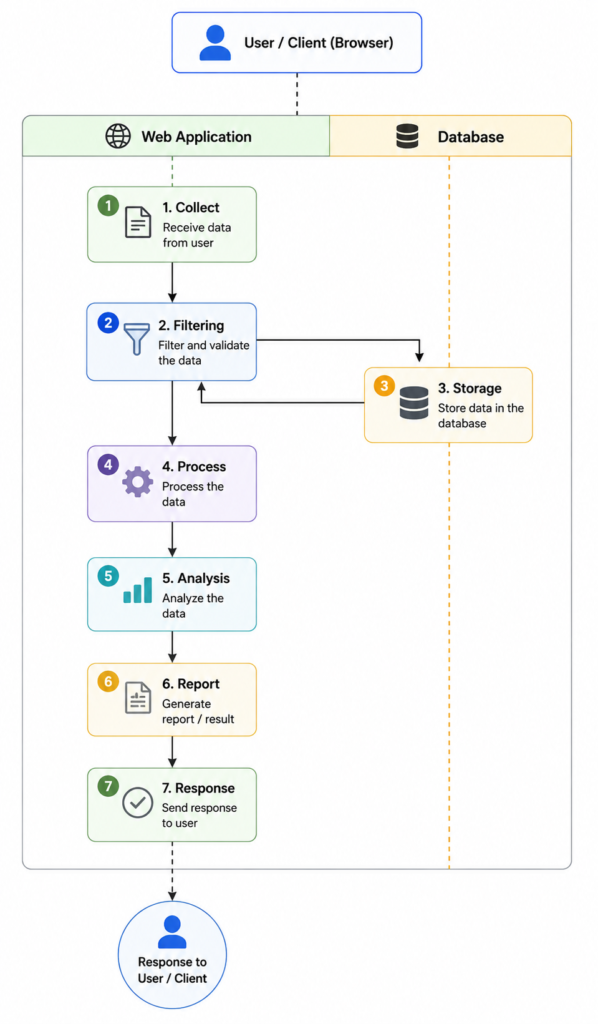
- Maintaining Records of Processing Activities (ROPA): Keeping updated documentation detailing what data is collected, where it flows, and who has access to it.
- Conducting Data Protection Impact Assessments (DPIAs): Evaluating privacy risks before launching new features, products, or AI integrations.
- Continuous Monitoring: Implementing continuous privacy monitoring across development pipelines to ensure compliance policies remain active over time.
- Auditing Data Workflows: Periodically generating a comprehensive privacy report to benchmark system architecture against regulatory expectations.
Actions That Violate Accountability:
- Implementing privacy policies on paper while maintaining zero technical controls or audit trails in software systems.
- Failing to assign clear roles and responsibilities for data governance and incident response.
Practical Checklist: Auditing Your Organization’s Actions
Use this 8-point verification checklist to determine whether your current operations uphold foundational privacy principles:
- Data Minimization: Have all signup and contact forms been audited to remove non-essential fields?
- Direct Correction: Is there a clear, documented procedure (or self-service tool) for users to update or correct their personal data within 30 days?
- Purpose Specificity: Is personal data stored separately from secondary marketing and advertising systems?
- Automated Retention: Are automated purge jobs configured to delete expired sessions, inactive accounts, and temporary logs?
- Transparent Notice: Is your privacy policy written in plain English, clearly outlining all third-party sub-processors?
- Unbundled Consent: Are consent requests presented with unchecked boxes and clear opt-in options?
- Encryption & Secrets Management: Are all personal data stores encrypted at rest and free from hardcoded API keys in application source code?
- Continuous Auditing: Do you run continuous security and privacy scans against your codebase and cloud endpoints?
Frequently Asked Questions (FAQs)
Which action upholds a privacy principle in a standard compliance exam?
In almost all compliance multiple-choice questions, “correcting personal information when requested by an individual” is the action that upholds a privacy principle (specifically Data Accuracy). The incorrect choices typically describe hoarding data (violating data minimization), keeping records forever (violating storage limitation), or using data for undisclosed purposes (violating purpose limitation).
What is the difference between data minimization and purpose limitation?
- Data Minimization focuses on the quantity and scope of data collected—you must only collect the smallest amount of data necessary.
- Purpose Limitation focuses on the use and objective of the data—you must only use the data for the specific reason you originally explained to the individual.
How does “Privacy by Design” relate to privacy principles?
Privacy by Design is the engineering methodology of embedding privacy principles directly into the architecture of IT systems, software applications, and business processes from the very start of development, rather than attempting to bolt on compliance features as an afterthought.
What should an organization do when an individual requests a data correction?
Under regulations such as GDPR (Article 16) and CCPA/CPRA (Cal. Civ. Code § 1798.106), an organization must:
- Verify the identity of the requester to prevent unauthorized modifications.
- Update the inaccurate data in primary databases and active application caches without undue delay (typically within 30 days).
- Notify any downstream third-party processors who received the inaccurate data.
- Send formal confirmation to the individual once the update is complete.

Leave a Reply